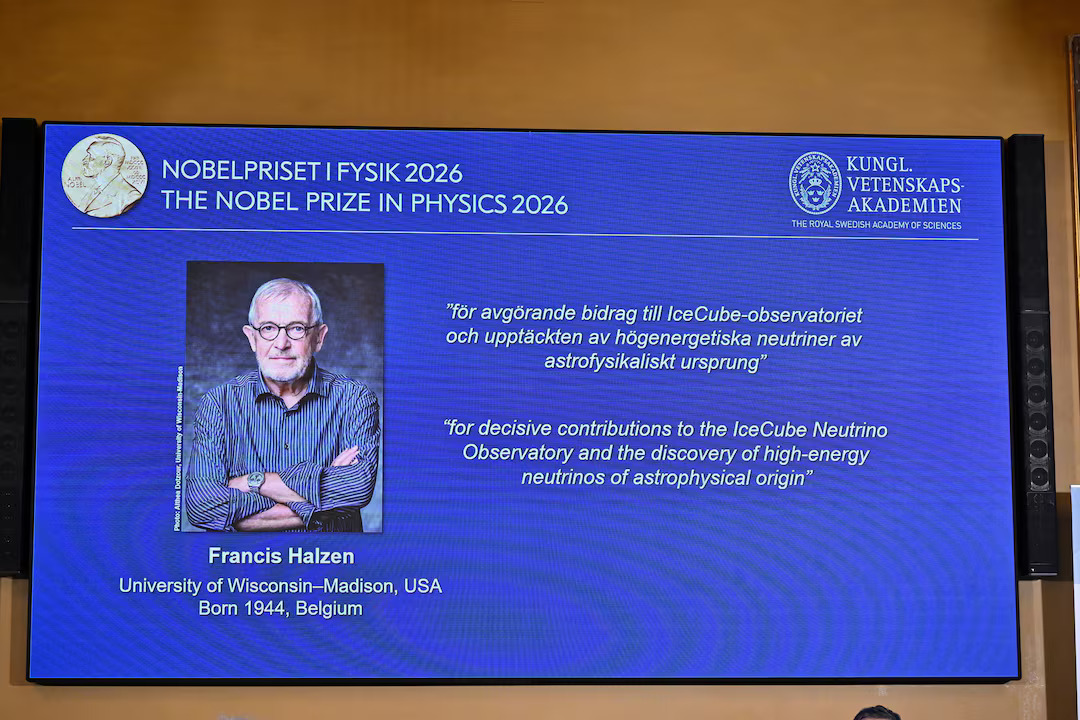
Francis Halzen wins Nobel Physics Prize for Antarctic ‘ghost particle’ hunt
Summary
Francis Halzen has won the 2026 Nobel Prize in Physics for helping create the IceCube observatory, which detects elusive high-energy neutrinos in Antarctic ice. The award recognizes a project that could reveal how some of the universe’s most powerful cosmic events generate these “ghost particles.”
Key Points
- Francis Halzen won the 2026 Nobel Prize in Physics for his work on detecting high-energy neutrinos with the IceCube observatory in Antarctica.
- The IceCube detector uses more than 5,000 sensors buried in a cubic kilometre of South Pole ice to trace neutrinos back to their sources.
- Scientists hope the observatory will help explain phenomena such as exploding stars, gamma-ray bursts, black holes and neutron stars.
- The Nobel Prize comes with 12 million Swedish crowns and was established under the will of Alfred Nobel.